From Engineering to the UN: A Masterclass in Practicing Courage with Arekpitan Ikhenaode
Chinenye Oguadinma
Published 5/27/2026
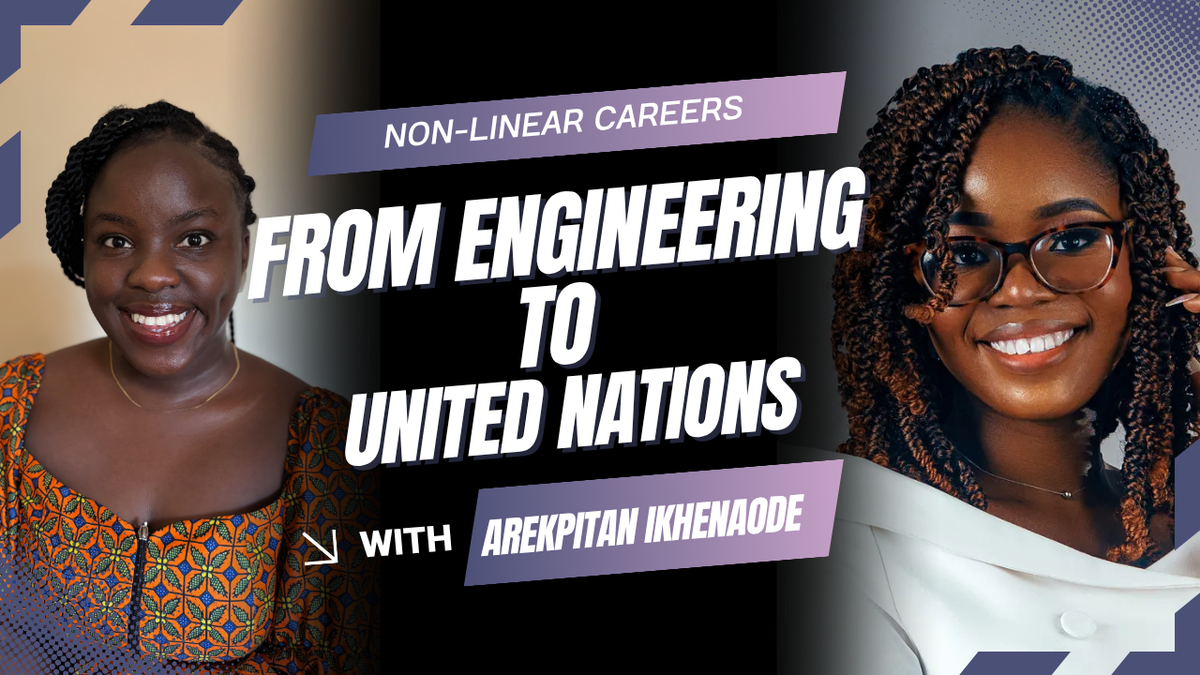
What do you do when you’re in a field everyone says is your "ticket to success," but your heart is somewhere else entirely?
For Arekpitan Ikhenaode, the answer was simple but far from easy: you ruffle some feathers, follow your instincts, and practice the art of courage until your nonlinear path starts to look perfectly linear.
I recently sat down with Arekpitan, a storyteller, development communicator, and current Communication Officer at a UN agency, ITCILO, to talk about her journey from studying Petroleum Engineering to working at the United Nations.
The "Troublemaker" with a Story to Tell
Arekpitan introduces herself with a title you don’t often see on a LinkedIn profile: Troublemaker.
"I like to ruffle feathers," she laughs. "I like to disturb, provoke, and expose things." But this isn't trouble for trouble's sake. It's the drive of a storyteller who cares deeply about social issues, gender equality, and justice.
Despite being a student in the sciences and choosing engineering of her own decision, Arekpitan realized early in her university days that she didn't want to practice it long-term. "I was holding two different thoughts: I want to pass my exams, but I don’t want to do this for the rest of my life."
The Myth of the "Linear" Career
One of the most profound insights Arekpitan shared is her belief that even
Nonlinear careers are actually linear when you look closely.
"When you look back, there’s usually a connecting thread between all those many interests," she explains. For her, that thread was communication and advocacy. Whether she was leading a debate club, starting a writer's community in the faculty of engineering, or watching documentaries about the Niger Delta, she was always moving toward her current role even before she had the name "Development Communications" for it.
Dealing with the Critics
When you tell people you’re leaving the "lucrative" world of oil and gas to become a writer or work with NGOs, you’re bound to get some looks. Arekpitan recalls the condescension she faced, especially during her industrial training and NYSC.
"Most of the people criticizing don't even know what you want to go and do," she notes. "I don’t expect people to know what something is to appreciate it."
Her advice for navigating this? Have a mind of your own.
You don't need to care about being liked, approved, or validated at every single step. Don't be afraid to stand alone.
How to Pivot: The Arekpitan Blueprint
So, how do you actually make the jump from a technical field to an international organization like the UN? Arekpitan’s journey was built on three pillars:
1. Pursue Your Interests Obsessively
Arekpitan didn't wait for a job offer to start being a communicator. She joined editorial units, started a book club, and even wrote to a journalist whose documentary resonated with her. That one email turned into a three-year correspondence and her first taste of journalism.
2. Practice Courage (It’s a Muscle!)
"I’m not courageous," she insists. "I practice courage. The more you practice it, the more it grows." This meant reaching out to mentors, applying for fellowships, and pitching herself for roles where she didn't have the "traditional" background.
3. Build Evidence
If you’re pivoting, you need "proof of work." For Arekpitan, this meant taking Google digital skills courses, volunteering to manage social media for a lecturer’s NGO, and eventually pursuing a Master’s in the Management of Development to bridge her knowledge gaps.
A Message to the Career "Pivoter"
To anyone currently feeling like a "slave" to a decision they made at age 16, Arekpitan has a clear message: Feel free to change your mind.
"The moment you realize you’re in the wrong direction, pivot," she says. "You bring all of yourself to the table, the analytical skills from engineering, the technical competencies, the unique perspective. None of it is wasted."
Final Thoughts
Arekpitan’s journey is a reminder that excellence and interest are the best recruiters. She never used Upwork or Fiverr; every writing gig she got came from people who had seen her work and said, "I heard you write."
As we wrapped up our conversation, one thing was clear: Arekpitan Ikhenaode didn't just leave engineering; she took the discipline and logic of an engineer and applied it to the passion of an activist. And she hasn't looked back since.
You can also watch the full interview on YouTube.
If you’re looking to gain clarity in your own journey, don't forget to check out the Non-Linear Career Workbook. It’s designed for professionals who refuse to be defined by a single path. Use the code NLC26 for a 30% discount!

Join the Non-Linear Community
Weekly frameworks for turning your diverse professional experiences into building something of your own.