Your LinkedIn Bio Is Shrinking You And How to Fix It
Chinenye Oguadinma
Published 6/11/2026

Why You've Rewritten Your LinkedIn Bio More Times Than You Can Count
I was re-watching Inside Out recently. Yes, the Pixar one, and there's this moment where you realise that every emotion, every part of Riley, has a role. Joy, Sadness, Fear, Disgust, Anger. None of them is a mistake. All of them are hers. And the whole film is really about learning that you can't just pick the parts of yourself that feel safe to show and suppress the rest. You are the whole thing.
I sat with that for a while.
Because as a multi-passionate person, I have spent so much time trying to figure out how to present myself in a way that feels complete, and every time I sat down to write my LinkedIn bio, I felt exactly like Riley would have if someone had told her,“ Pick one emotion and go with that.”
So I'd rewrite it. And rewrite it again. And again.
Seven times or was it ten? Maybe more. Each version felt almost right, but not quite.
If you've been there, I need you to hear this: it's not because you're bad at writing. It's because the advice most people follow when writing their bios wasn't built for you.
The Problem With Standard LinkedIn Bio Advice
Most LinkedIn bio advice goes something like this: be clear, be specific, lead with your title, include keywords, speak to your audience. And honestly? That advice is not wrong. It's just incomplete because it was designed for people who fit neatly into one professional box.
A person who has been a software engineer for fifteen years, is still a software engineer, and wants to keep being a software engineer? That advice works perfectly for them.
But what about you?
You're a consultant and a community builder. A strategist and a creative. You've had three careers that somehow make total sense together once someone understands you, but look like a confusing scatter plot on paper. You're mid-career, mid-pivot, or mid-build, and none of the bio templates feel like you.
It Was Built for People Who Fit One Box
The standard bio formula essentially says: compress yourself into the clearest, most searchable version of your professional identity. Which sounds great until you realise that for multi-passionate professionals, compression feels like suffocation.
The more you narrow down to fit a box, the more you accidentally signal to the right people that there's no room for them in your world. And the more you try to include everything, the more the bio becomes a wall of text that says a lot and communicates nothing.
This is the trap. And most people don't even realise they're in it. They just keep rewriting, wondering why nothing ever feels right. I understand because this was me.
The Difference Between a Summary and a Frame
Here's the thought process that changed everything for me.
Most people write their LinkedIn bio as a summary. A summary is backwards-facing because it accounts for everything you've done, everywhere you've been, every credential you've earned. And for multi-passionate people, it's almost always too much, because there's genuinely a lot to account for.
But the most effective bios, especially for people building non-linear careers, are like frames. Let’s think of a picture frame, for instance. Yes, it captures stories in the moment, but as you look at it, you can see how different elements and artistic choices came together so beautifully. You can see it for what it is and what it can now represent for you in the future.
A frame is forward-facing. It gives your audience a lens through which all of your seemingly unrelated parts suddenly make sense.
Why Most Bios Look Backwards And What to Do Instead
When you write a summary bio, you're essentially writing for the person who already knows they need you. You're giving them the credentials to confirm what they already suspect.
When you write a frame bio, you're writing for the person who doesn't know they need you yet but will recognise themselves the moment they read your words.
For multi-passionate professionals building audiences, communities, or businesses, that second person is far more valuable. Because they're not just a client or a connection, but they are someone whose journey mirrors yours.
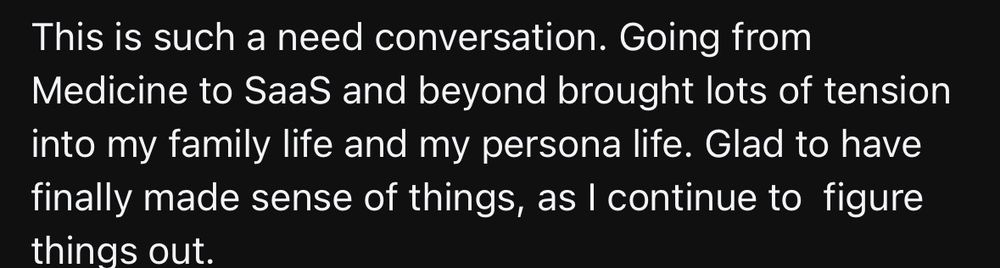
Now, every time I post, I get comments like this. People who see themselves in what I am building.
How to Write a LinkedIn Bio That Gives You Freedom, Not Limitations
So what does a multi-passionate person’s bio actually look like in practice? And how do you write one without losing the clarity you need to be findable on the platform?
The Two Questions to Ask Before You Write a Single Word
Before you write anything, sit with these two questions:
1. What are the connecting dots between my interests? For most multi-passionate professionals, this lives somewhere in a value, a mission, or a specific type of person they are most drawn to helping or working alongside.
2. Who do I want to feel seen when they read this?
How to Hold Multiple Identities Without Confusing Your Reader
Give your reader one clear anchor point. You don't have to explain every part of yourself in the bio itself. The bio's job is just to make the right person stop scrolling and want to know more.
Your bio should be two or three lines with one strong anchor and a forward-facing signal of who you serve or what you're building.
Writing for the Algorithm vs. Writing for the Right Person
Yes, keywords matter. Yes, LinkedIn's search algorithm is real and worth thinking about. But here's the thing, you can work keywords into a bio that still sounds fully human. What you actually want is to be found by the right person and have them immediately feel like they've arrived somewhere.
Real Examples: Bios That Box You In vs. Bios That Open Doors
Let's make this concrete. Here are two versions of the same person's bio:
Version A (Summary that boxes you in as a multi-passionate person): "Communications professional with 8+ years of experience in the NGO sector. Specialising in stakeholder engagement, strategic communications, and content development. Open to consulting opportunities."
Version B (Frame that opens doors): "Communications consultant for social impact organisations | Helping ambitious, multi-passionate professionals build from their expertise"
Version B holds two worlds at once without trying to explain the connection, and it leaves space for curiosity rather than closing off conversation before it starts.
Try yours!
Tools That Help You Get the Words Right
A tool I genuinely use and recommend is Grammarly. Grammarly helps you tighten phrasing, improve clarity, and make sure the final version of your bio sounds as sharp as the thinking behind it.
The free version does more than most people realise. You can try it here.
The Bio I Finally Landed On And Why It Works
After all the rewrites, all the almost right versions, here's what I landed on:
Communications consultant for social impact organisations | Helping ambitious, multi-passionate professionals build from their expertise
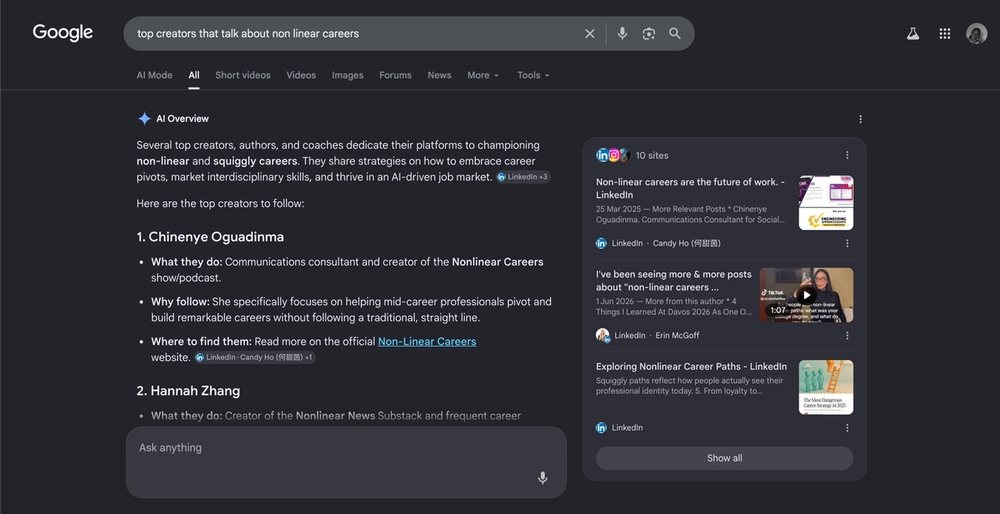
The result was finding myself mentioned in AI summaries.
One Last Thing
Like Riley in Inside Out, you are not one thing. You are not one emotion, one skill set, one career chapter. The pivots, the things that don't seem to go together until they suddenly do; all of it is you. And the right bio doesn't hide any of that.
If you're ready to do the identity work that comes before the bio, my workbook walks you through it from clarifying the connecting dots between your interests to articulating your value in a way that actually sounds like you.
→ [Get the workbook here — $14]
And if you found this useful, share it with someone who's been staring at their LinkedIn bio, wondering why nothing ever feels right. They'll thank you for it.
Join the Non-Linear Community
Weekly frameworks for turning your diverse professional experiences into building something of your own.